


An Introduction to Holo Stats
Welcome reader, as this is the first blog post and first edition of Holo Stats I’m going to give a little explanation of what my goals are for Holo Stats and my other posts on this site.
My name is Tim, and I’m currently pursuing a Master’s degree in Project Management. My research focuses on the digital content landscape, including content creation and video games. I’m deeply interested in exploring how data and project management principles can provide new insights and support for digital creatives. Through this blog, I aim to combine my academic background with my love for data analysis to offer fresh perspectives on industries like VTubing, gaming, and content creation.
During my time living in Tokyo, I discovered the world of VTubers and quickly became captivated by its unique approach to content creation. Hololive, in particular, stood out to me—not just for its talented performers, but also for the innovative way it operates as an organization. This fascination led me to create Holo Stats, a monthly analysis of Hololive’s performance metrics, including views, Super Chat revenue, number of streams, likes, and more.
Think of this as a data-driven monthly review of Hololive’s activities. While other fans might focus on highlights or personal favourites, I’ll be using data as our guiding hand to uncover trends, identify standout moments, and explore what makes this ecosystem so dynamic. That said, this isn’t about ranking talents by “merit”—after all, content creation is deeply personal, and there’s no objective “best” or “worst.” Instead, it’s about celebrating the diversity of talent and understanding how different factors contribute to their success.
An explanation of the Views vs Super Chat Revenue Model for Analysis
The Supa/Views Matrix: Measuring Engagement in VTubing
VTubing continues to thrive as a dynamic and innovative digital medium, but how do we measure success in such a diverse and creative space? Enter the Supa/Views Matrix, a data-driven model designed to provide a bird’s-eye view of how Hololive talents performed during a given month.
It’s important to emphasize that this data isn’t meant to rank or quantify the quality of any individual talent. Instead, it offers another lens through which to explore the latest trends and highlights within Hololive. After all, success in content creation is multifaceted, and what resonates with one audience might not resonate with another.
Understanding the Scatter Graph
Take a look at the scatter graph above. Here’s what you’re seeing:
Y-axis: Super Chat revenue (in JPY).
X-axis: Total channel views (excluding Shorts).
This simple yet powerful visualization allows us to compare two key metrics of engagement: audience reach (views) and financial support (Super Chats).
Why Super Chat Revenue vs. Views?
When it comes to measuring engagement for VTubers, there are countless variables to consider—likes, number of streams, peak concurrent viewers, and more. However, views and Super Chats provide a broader and more straightforward understanding of how talents are connecting with their audiences.
Streaming is the Bread and Butter: For most VTubers, live streaming is the core of their content. Super Chats, in particular, are a significant source of revenue and a direct way for fans to show their support.
Different Fanbases, Different Dynamics: Some talents have fanbases that are more inclined to send Super Chats, which can lead to higher revenue even if their view counts are lower. This dynamic highlights the unique rapport each talent has with their audience.
The Nuances of Super Chat Revenue
While Super Chat revenue is a valuable metric, it’s not without its caveats:
Special Occasions: Events like birthday streams or graduation streams often generate a surge in Super Chats, which can skew the data for that month.
Premieres vs. Long Streams: Talents who premiere video content (e.g., music videos) may receive Super Chats during the premiere window (typically 30–60 minutes). On the other hand, talents who stream for extended periods may accumulate more Super Chats over time.
Why Include Views?
Views provide an essential counterbalance to Super Chat revenue. They help us recognize talents who may not rely heavily on streaming but still create highly engaging content, such as music videos or collaborative projects. For example:
Talents who focus on video content may have higher views but lower Super Chat revenue.
Talents who stream frequently may have lower views but higher Super Chat revenue.
By combining these two metrics, we can identify the sweet spot where talents achieve both high engagement and strong financial support. This approach allows us to celebrate the diversity of content creation within Hololive and appreciate the different ways talents connect with their audiences.
Acknowledging the Limitations
While the Supa/Views Matrix is a useful tool, it’s not without its flaws. Here are a few important considerations:
Content Variety: Talents who create diverse content (e.g., music, gaming, talk streams) may not fit neatly into this model.
Audience Behaviour: Some fanbases are more financially supportive, while others may engage more through likes, comments, or shares.
External Factors: Events like collaborations, anniversaries, or external promotions can temporarily boost views or Super Chats.

Clippers: The second-hand engagement market
Clippers are an integral part of the VTuber community, acting as a bridge between talents and their audiences. These dedicated individuals take highlights from streams—whether they’re funny moments, heartfelt interactions, or epic gameplay—and edit them into bite-sized clips for others to enjoy. Some clippers even go the extra mile by adding creative edits, subtitles, or translations, making content accessible to a global audience.
These clips can range from short 3–5 minute highlights to longer 20–30 minute segments, offering viewers who missed a live stream the chance to catch up on the best moments without watching the full VOD. But clippers do more than just recap streams—they also play a crucial role in discovery. For many fans, a well-edited clip is their first introduction to a VTuber, often leading them to explore the talent’s main channel and engage with their content.
Hololive’s Support for Clippers
Hololive recognizes the value of clippers and actively encourages their work. Unlike many content creators who might view fan-made clips as copyright infringement, Hololive has established clear rules and guidelines for clippers and other derivative content creators. These guidelines ensure that fan creativity is celebrated while protecting the interests of the talents and the agency. You can read more about Hololive’s policies here: Hololive Derivative Works Guidelines.
Why Clippers Aren’t Included in the Supa/Views Model
While clippers play a significant role in driving engagement, the Supa/Views Model focuses solely on data from the talents’ official YouTube channels. There are a few reasons for this:
Data Accessibility: Tracking the impact of clippers is challenging because their content is spread across countless channels and platforms. Unlike official streams, there’s no centralized way to measure the views, likes, or Super Chats generated by fan-made clips.
Focus on Direct Engagement: The Supa/Views Model is designed to analyze the direct relationship between a talent’s content and their audience. By focusing on official channel metrics, we can maintain a clear and consistent framework for comparison.
Complexity of Attribution: Even if a clip goes viral, it’s difficult to quantify how much of that engagement translates to the talent’s main channel. While clips undoubtedly contribute to a talent’s popularity, their impact is often indirect and harder to measure.
Acknowledging the Impact of Clippers
That said, it’s important to recognize the indirect influence clippers have on the metrics we’re analyzing. A viral clip can lead to a surge in subscribers, views, or Super Chats on a talent’s official channel, even if that impact isn’t directly captured in the Supa/Views Model. In future analyses, I hope to explore ways to incorporate the role of clippers and fan-made content into our understanding of VTuber success.
February 2025: Full analysis:
A few major outliers
It’s important to acknowledge there are 4 Talents of the current active 67 who are difficult to analyse via the Supa/Views model:
Hoshimachi Suisei
Oozora Subaru
Amane Kanata
Ichijou Ririka
These talents do not have Super chats turned on for various reasons. Some of which are temporary and other are permanent. Some times super chats are turned off due to Hololive not having permission to monetise certain video games. This is a decision not up to Hololive or the talent and dependant on the policy of the copyright holder.
Alternatively some talents may decide to turn off super chats willingly. Hoshimachi Suisei outlined her reason for pausing super chats is that she feels as if she’s not dependant on the revenue from super chats and that buying merch is a better way to support her and Hololive.
To see more about Suisei rationale for pausing super chats you can watch this translated clip provided by Youtube clipper Yura here:
The 4 aforementioned members earned a total of 0JPY (Japanese Yen) from super chats in February however there is always the possibility that they reenable super chats sometime in the future in which case the Supa/Views model will more accurately display these members engagement.
Super Chat Revenue
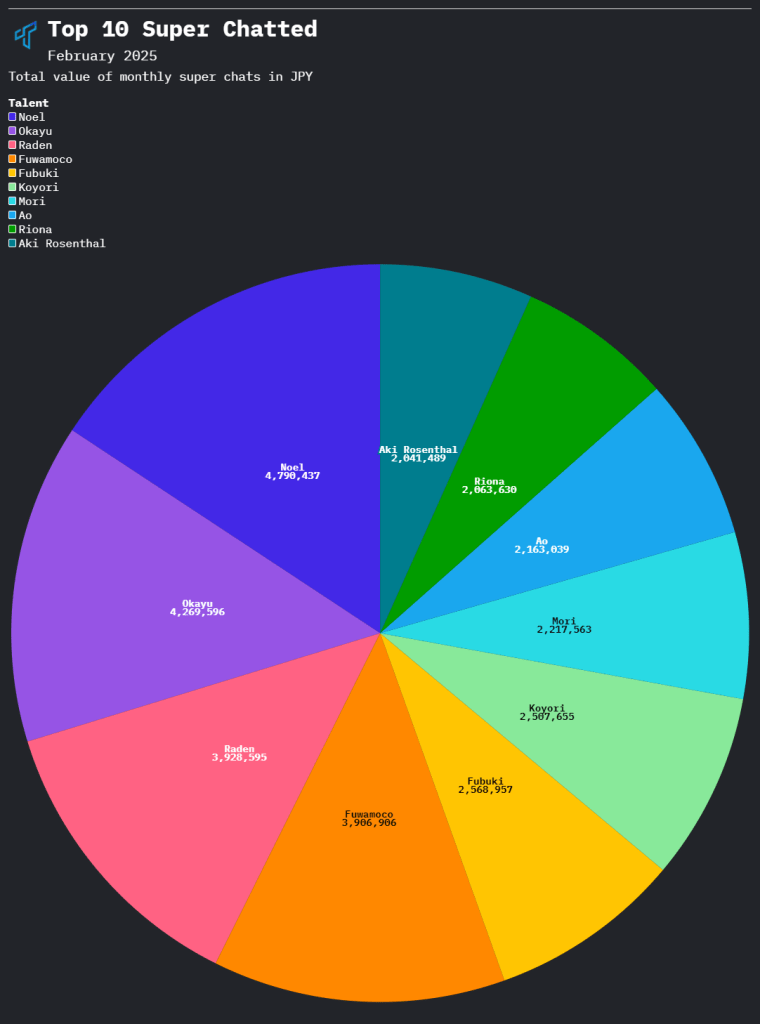
Shirogane Noel sits a top as the highest earner from Super Chats in February with just under 4,800,000 JPY (approx. $31,735)beating out Okayu who sits in 2nd. Of the top 10 Super Chat earners 5 of them belong to Hololive Japan where as a further 3 belong to DEV_is which is also a Japan based branch. Meaning Mori Calliope and Fuwamoco are the only non JP talents to make the top 10. It is worth noting these 2 aforementioned talents do reside in Japan and engage with Japanese audiences, emphasising the Japan centric dominance of Hololive.
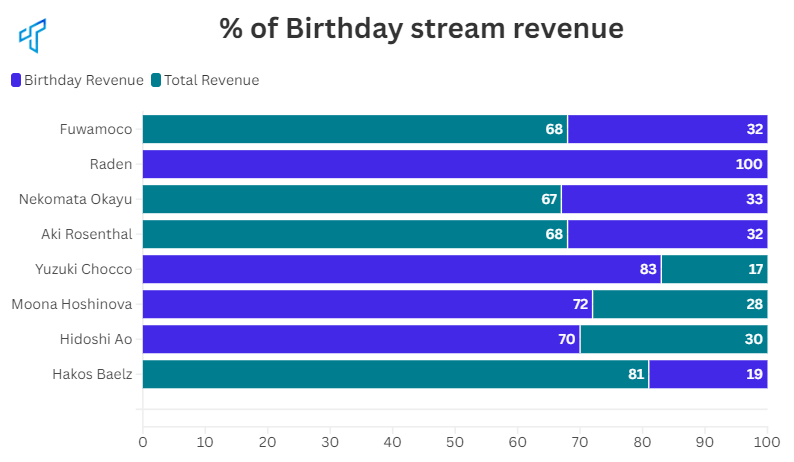
Raden, Okayu, Fuwamoco, Ao and Aki Rosenthal all had birthdays this month among others who didn’t make the top 10. Birthday streams have accounted for a large portion of their Super Chat revenue this month.

Birthday streams:
Fuwamoco – 1,239,729 JPY which is 32% of Fuwamoco’s total revenue in February – https://www.youtube.com/watch?v=ouQF2A1l_cI
Raden – 3,928,595 JPY, yes that is 100% of Raden’s revenue this month. Raden has had her Super chats disabled for some time. Her first ever Birthday stream was planned long in advanced and featured a flurry of guests. https://www.youtube.com/watch?v=f5QgEZjH53Y
Nekomata Okayu – 1,427,801 JPY 33% of her total super chat revenue in February – https://www.youtube.com/watch?v=T_gRbxFT-Sc
Aki Rosenthal – 657,536 JPY 32% of her total super chat revenue in February – https://www.youtube.com/watch?v=etiR9Qnqlmc
Yuzuki Chocco – Chocco’s Birthday takes place on the 14th of February which is a big day for Hololive streamers, she conducted a Birthday countdown on the night of the 13th ticking over into her Birthday which made 69,881 JPY in super chats about 36% of her total revenue before streaming a Birthday live on the 14th that made 91,245 JPY (47% of her total revenue) which combined gives us 83% of her Super chat revenue this month was from these two streams (161,126 JPY out of 194,108 JPY total revenue)- https://www.youtube.com/watch?v=etiR9Qnqlmc
Moona Hoshinova – Moona had a similar approach with her Birthday being on the 15th of February with her Birthday countdown gaining 69,421 JPY and her actual Birthday stream gaining 215,710 JPY which combined is 72% of her total 394,222 JPY revenue gained in February. – https://www.youtube.com/watch?v=4JNyad4TTuY
Hidoshi Ao – Ao shares a birthday with myself but unlike me was able to generate an impressive 1,519,450 JPY compared to the fluffy socks my mother gifted to me, that impressive figure is 70% of Ao’s total revenue for the month. – https://www.youtube.com/watch?v=PyQ4-6-TeRI
Hakos Baelz – Leap year born Baelz has the choice of February of March for her Birthday, this year she opted to stream on the 28th of February generating 330,771 JPY only 19% of her total revenue of 1,737,992 JPY. – https://www.youtube.com/watch?v=viPlIHvk724
How Impactful are Birthday streams?
The scope of Birthday streams can vary from talent to talent and year to year, it’s not required for a talent to have a large 3D event for their Birthday stream. Birthday streams however among Hololive’s most exciting projects for any given month and generate a chunk of revenue from super chats but also come with their own exclusive merch which generates further revenue.
Unfortunately there’s no accurate way to measure how much money is made from Merch sales on the Hololive official store, 3rd Party stores such as GeekJacks also sell Birthday which further presents challenges in estimating the true amount…..
Concerning Birthday Merch?

Raden’s Birthday collection merchandise is priced at 20,000 JPY (approx. $130) however fans are able to buy each individual item for various prices but for arguments say let’s say you can only buy the merch as a set for 20,000 JPY this would only take 196 sales to match the 3,928,595 JPY made from Super chats on Raden’s birthday stream. With her Birthday stream reaching 705,000 total viewers we can make a positive guess that more than 196 people bought her Birthday Merchandise but this isn’t conclusive.
It’s also worth noting that different talents will have different variations of Birthday merchandise that will vary in price and different fan groups may have their own behaviours when it comes to buying merchandise. With this acknowledge we’re in very unknown territory when estimating the amount Hololive make from Birthday merchandise specifically but we can give a fairly confident educated guess that Merchandise revenue succeeds that of Super Chat Revenue.
Understanding Super Chat Behaviour
The Impact of Birthday Streams:
One of the most fascinating aspects of analysing Super Chat revenue is observing how different fanbases behave.
On average, for those who had a birthday this month, 49% of a talent’s total monthly Super Chat revenue came from their birthday stream. (Note: Raden was excluded from this analysis.)
However, when we remove Choco from the average—her birthday coincided with Valentine’s Day, which likely inflated her Super Chat engagement—the average drops to 43%.
What Does This Mean for Next Month?
At first glance, you might wonder: “Does this mean these talents will see a 43% drop in Super Chat revenue next month?” The answer is a resounding no. Here’s why:
Context Matters: Data doesn’t exist in a vacuum. In this case, the high concentration of Super Chats during birthday streams reflects the special significance of the occasion. Many regular Super Chatters likely chose to focus their donations on the birthday stream as a way to celebrate their favourite talent.
Revenue Distribution: While we may see a decrease in Super Chat revenue for these talents in March, it’s unlikely to be as drastic as 43%. Instead, we can expect their revenue to be more evenly distributed throughout the month, as fans return to their usual donation patterns.

The Bigger Picture
This analysis highlights an important principle in data interpretation: context is key. While birthday streams create a temporary spike in Super Chat revenue, they don’t necessarily indicate a long-term trend. Instead, they reflect the unique ways fans choose to show their support during special occasions.
In future months, I’ll continue to explore how different events—whether it’s anniversaries, collaborations, or seasonal celebrations—impact Super Chat behaviour. By understanding these patterns, we can gain a deeper appreciation for the dynamic relationship between talents and their fanbases.
Total Channel Views
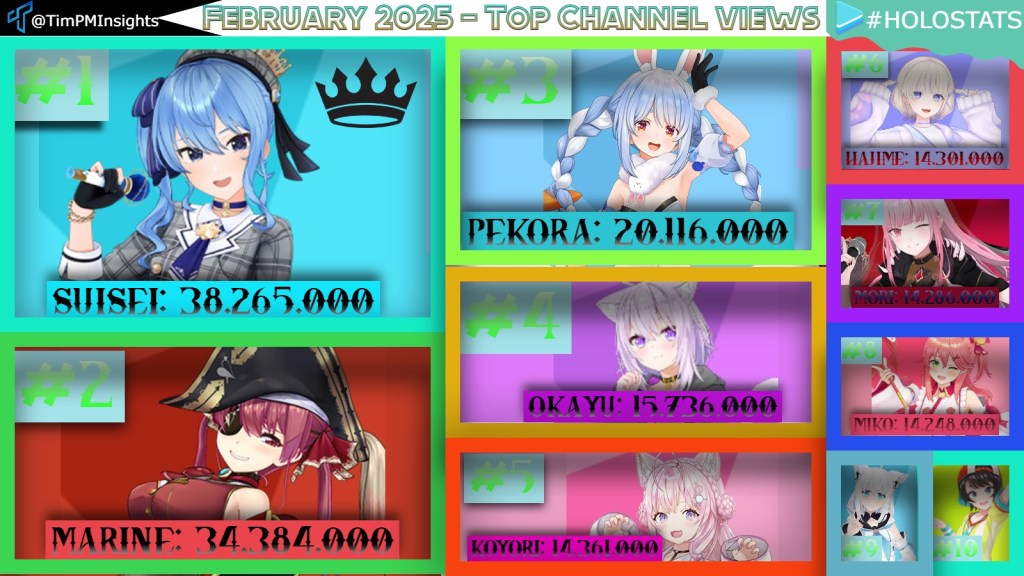
The Japan dominance continues looking at total views for February with Suisei leading with an impressive 38,625,000 views. While super chat revenue is a very stream dependant stat, views given talents who lean more towards music or other forms of videos some more of the spotlight.
Music tends to create inflated view numbers on Youtube as a whole, this does explain why we see Suisei take the crown this month and why we will likely see her always floating around the top 10 for views within Hololive.

Suisei started the month by performing at Budokan in Chiyoda, Tokyo after the release of her 3rd album Shinsei Mokuroku, the Youtube live stream for her live hit 750,000 views which is only 2% of Suisei’s total views in February she also only streamed an additional 6 times in February none of which even met the 750,000 of her Budokan live, so where are the views coming from?
Well from Suisei’s non Budokan streams in February she average about 480,000 viewers per stream, if we compare that to 2nd place Marine we see across 10 streams in February Marine only average 410,000 viewers per stream.
Looking at total stream views in February:
Suisei : 3,630,000 from 7 streams (including Budokan live)
Marine: 4,100,000 from 10 streams

Why Total Channel Views Matter: A Look at Long-Term Engagement
When analysing Hololive talents’ performance, one question often arises: Is it fair to include total channel views in the Supa/Views Model? After all, these views aren’t just from live streams—they also include older videos, such as music videos, that continue to attract viewers long after their release. Let’s dive into why this metric is not only fair but also essential for understanding the full picture of a talent’s engagement.
Take Suisei and Marine, for example. This month, Suisei had more viewers per stream on average, but Marine streamed more frequently, resulting in higher total stream views. However, the real story lies in their music videos—a testament to the long-term impact of their creative projects.
Suisei’s “BIBBIDIBA” music video, released in March 2024, has amassed over 121 million views (as of writing) and continues to grow.
Marine, too, boasts multiple music videos with over 35 million views each such as Bishoujyo Muzai, I’m your treasure box and III.
These videos contribute significantly to their total channel views, creating what I like to call “views dividends”—an investment in content that continues to pay off month after month. In contrast, Super Chat revenue is more transient, reflecting only the financial support received during a specific period.
Is This Fair?
At first glance, it might seem unfair to give Suisei and Marine “credit” for views generated by videos they released months or even years ago. But when we consider the effort and resources that go into creating such content, it becomes clear that these views are a well-deserved reward for their hard work.
A Project Management Perspective
From a project management standpoint, Hololive operates in an agile environment where multiple projects are conceived, planned, executed, monitored, and closed simultaneously. This includes everything from collaborative efforts like Holo GTA and EN Reco to individual talents’ passion projects, such as music videos.
Creating a music video is no small feat. It involves a wide range of deliverables, including:
Lyric production and recording sessions.
Art commissions and 3D animation.
Marketing material creation and quality assurance.
All of this work happens behind the scenes, often requiring talents to contribute significant time and effort off-stream. For example, if Suisei’s “BIBIDIBA” took 11 months to produce, the views it generates today are a direct result of that investment. In other words, the success of a music video isn’t just a one-time achievement—it’s a long-term contribution to a talent’s engagement and popularity.
Why Total Views Belong in the Model
Including total channel views in the Supa/Views Model acknowledges the long-term impact of a talent’s work. It recognizes that success isn’t just about what happens in a single month but also about the legacy of their creative projects. By capturing these views, we gain a more holistic understanding of how talents connect with their audiences over time.
Valentines day

Valentines day is a pretty big deal for Hololive, but it’s significance will vary depending on talent. Fans will often use valentines day as an excuse to send big Super chats to their favourite talents, often referred to as ‘Oshis’. It’s also a massive event for merchandise with Hololive realising voice packs, acylic stands and much more.
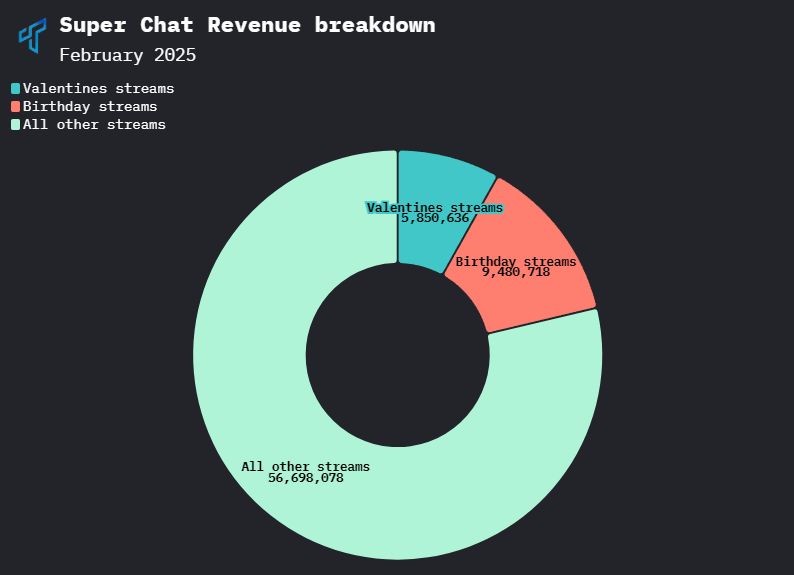
Valentines streams saw a total revenue of 5,850,636 JPY (approx. $39,245) which comes out at 8% of Hololive’s total super chat revenue for the month. Birthday streams accounted for 13% of super chat revenue.
While Valentines day saw a chunk of super chat income these numbers show that Hololive still generates much of it’s super chat revenue from it’s talents regular streams and Birthday streams. An interesting metric to look at next month will be the affect Valentines had on Birthday streams, did fans make a decision to donate on a Valentines stream as opposed to a Birthday stream? Did Valentines day draw away some of the donations and engagement normally accounted to Birthday streams?
Summary
This was my first ever blog post and not just my first edition of Holo Stats. I intend to keep this trend up monthly but would really appreciate if you could provide any feedback. What areas did you like? what areas didn’t you like? Should I continue focusing solely on statistics or should I have taken a look more directly at the content of the month such as this months new Minecraft resurgence and the number of JP and EN interactions we were treated to this month?
This is really something I want the readers to help me shape over the coming months to hopefully create some real thoughtful and engaging content about Hololive. I’ll also be writing a lot more blogs some about Hololive some about other industries which may not be as data heavy and more about my own qualitative insights as a Project Management academic.
Be sure to leave any comments and share this blog around if you’d be so kind you can also check my X (Twitter account) where I’ll be posting some more brief infographics and statistics as well as engaging with other fans.
Thank you for reading and have a wonderful March and Holo Fest!
 Tim Browne - Consultant and Researcher for Creatives