
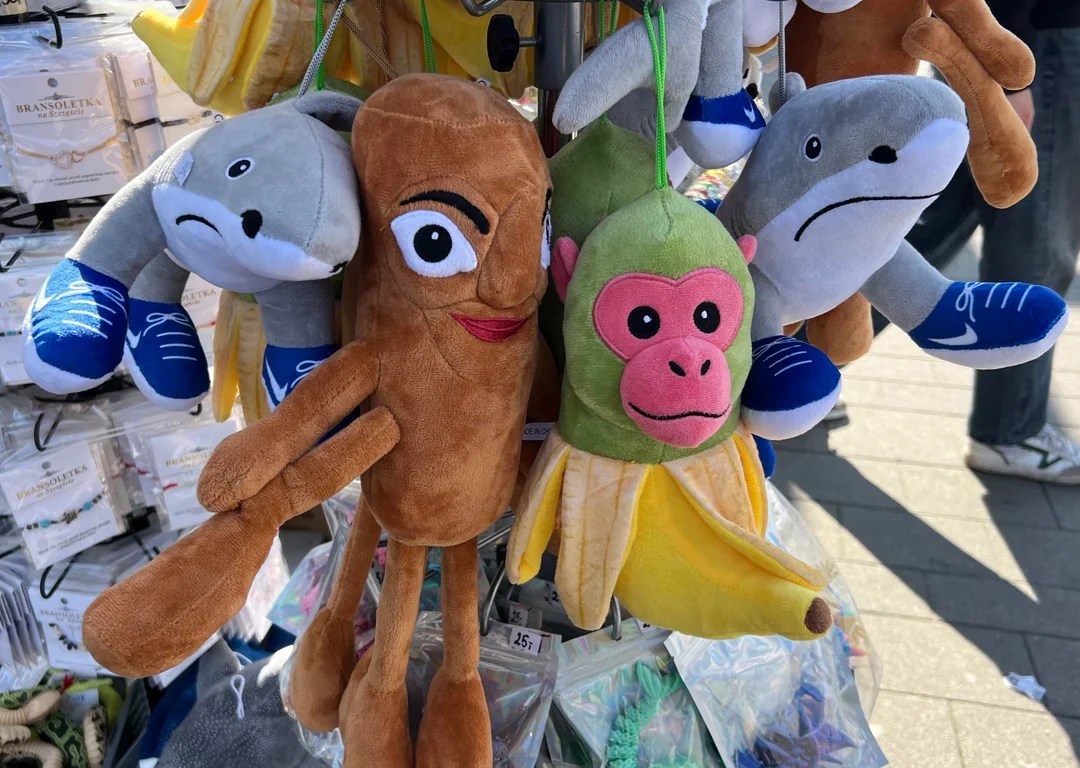
Italian Brainrot is not really a brand, a franchise, or even a coherent creative project. It is a label that got stuck to a wave of AI-generated absurdist characters that flooded short-form video and somehow ended up on plush toys, soda cans, and merchandise shelves worldwide. If you work in entertainment IP, the temptation is to log it as a weird little footnote and move on. That would be a mistake, because what happened here has not happened before and it is not going back in the box.
The IP situation around Italian Brainrot is genuinely murky, and honestly that murkiness is the whole story. Under current copyright interpretation, AI-generated characters cannot be owned by whoever prompted them into existence. Some of the more prominent characters do have a partial commercial claim attached, largely because a Roblox game (Steal a Brainrot) was built around them and that studio (DoBigStudios) established some footing, but the broader ecosystem of content, merch, and derivatives exists in a grey zone where enforcement is basically impossible. Merchandise companies can sail in, manufacture product off characters they did not create and do not license, take their cut, and leave. Nobody can stop them. Nobody even knows who to call. This is not fan creativity orbiting a central IP holder. It is commercial activity with no centre of gravity, and we have not seen that at this scale before.

Part of what makes it so hard to respond to is the speed. Italian Brainrot spread as fast as it did because hundreds of unconnected creators were all contributing simultaneously, with no approval chain slowing any of them down. No traditional IP holder can match that. Even Hoyoverse, which is probably one of the most algorithmically agile major operator in this space, cannot flood an audience from that many directions at once. Pokémon has decades of creative investment behind it and genuine cultural weight, and none of that is much help when the competition is a self-replicating trend with no bottleneck anywhere in the system. Acquiring these characters is not a real solution either. Any company that tried would inherit every piece of content ever made around them, including the offensive stuff, the sexual stuff, and everything else that AI generation makes inevitable. That liability follows the acquirer regardless of when the content was made. For most major IP holders, and Japanese companies especially, that risk calculus does not come close to working out.
The deeper worry, though, is what this does to the generational pipeline. The business model of a Pokémon or a Lego is built on a very specific kind of slow burn. You reach children early, you build genuine emotional resonance, and you collect on that loyalty for decades. That is why a thirty-year Pokémon anniversary can still move serious product. The adults buying it grew up with Pikachu at seven or eight years old and they are, in a very real sense, paying tribute to their own childhood. Lego has done the same thing with its premium adult ranges. But for that flywheel to keep working, both companies have to keep finding new children, and that is where the problem sits. These ownerless AI trends compete directly for that early attention window, and they compete with tools that are faster and cheaper than anything a traditional studio can field. The characters burn bright, generate enormous short-term engagement, and then disappear before any lasting bond has formed. That is the candle. And the children whose most receptive years were absorbed by trends that no longer exist are not going to grow up with a loyalty pipeline attached to anything. That attention does not come back around.
 Tim Browne - Consultant and Researcher for Creatives