

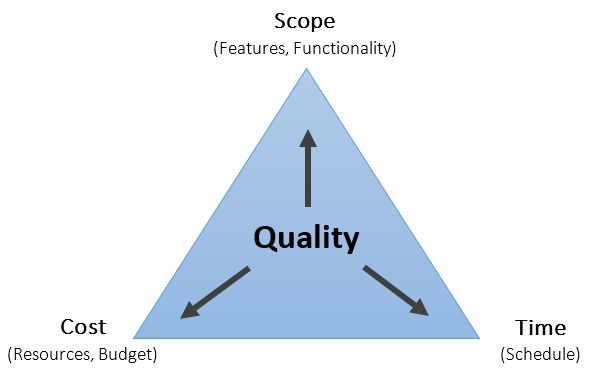
If you’ve ever played a game that looked great on paper but just didn’t hit right, you’re not alone. Behind the scenes, game development teams use project management tools to plan and deliver games. One of the oldest and most common is the Iron Triangle a model that balances Time, Cost, and Scope (or sometimes Quality, depending on who you ask).
The idea is simple: if you want to make a game quickly, you either reduce how much is in it (scope) or throw more money at it (cost). And if you want all three a big, high-quality game, done fast and cheap you’re probably dreaming.
But there’s a catch: this model doesn’t really work for creative projects like video games.
Scope Isn’t the Same as Quality
In traditional industries, like manufacturing or construction, “quality” might mean everything works and nothing breaks. But in games, quality is often emotional and experiential is the game fun? Are the characters memorable? Does the world feel alive?
Let’s take a real-world example. In 2022, Bungie released The Witch Queen, an expansion for Destiny 2 that was praised for its story, gameplay, and world-building. A year later, Lightfall followed with a similar budget, development time, and amount of content basically, it ticked all the same Iron Triangle boxes.
But players hated it.
Despite meeting all the “measurable” expectations, Lightfall was received poorly, earning just 29% positive reviews on Steam compared to The Witch Queen’s 72%. The difference? Players said Lightfall felt uninspired, rushed, and creatively empty.
So What Went Wrong?
From a project manager’s point of view, Lightfall was a success: it was released on time, within budget, and had a full set of new missions and features. But from a player’s perspective, it failed where it mattered most: in delivering a meaningful, enjoyable experience.
That’s the flaw in the Iron Triangle. It doesn’t leave room for creative quality, and in game development, that’s often the most important factor of all.
What Should Replace It?
Many studios now use more flexible methods, like agile development, user feedback loops, and iterative testing, to build around the unpredictability of creativity. These approaches accept that fun can’t be scheduled, innovation can’t be budgeted precisely, and sometimes the best features emerge halfway through development.
Bottom Line
Next time you wonder why a game turned out the way it did, remember: it might have “succeeded” in the boardroom but failed in the controller. Creative industries need creative ways of measuring success — and the Iron Triangle just doesn’t cut it anymore.
Join the conversation
Please feel free to give me any feedback either in the comments below or you can find me on twitter @TimPMInsights where I post regular insights, statistics and just my general thoughts on video games and similar industries.
Enjoy my blogs? You can can always leave a like and subscribe (it’s free) so whenever I release something new you’ll get it straight to your email inbox. It’s much appreciated!

 Tim Browne - Consultant and Researcher for Creatives